A wide ranging commentary and dialogue
on the media, politics, today's headlines and the popular culture. Always fresh and new every day! Now celebrating our second decade and more than 25 million page views. Nationally recognized, widely quoted, newsworthy, noteworthy.
Every day this month we will spotlight a different noteworthy Italian-American.
Vincent Robert Capodanno Jr. (February 13, 1929 – September 4, 1967)
Vincent R. Capodanno Jr. was a Catholic priest and Maryknoll Missioner killed in action while serving as a Navy chaplain with a Marine Corps infantry unit during the Vietnam War.
He was a posthumous recipient of America's highest military decoration, the Medal of Honor, for heroic actions above and beyond the call of duty. The Catholic Church has declared him a Servant of God, the first of the four stages toward possible sainthood.
From his military citation:
For conspicuous gallantry and intrepidity at the risk of his life above and beyond the call of duty as Chaplain of the 3d Battalion, in connection with operations against enemy forces. In response to reports that the 2d Platoon of M Company was in danger of being overrun by a massed enemy assaulting force, Lt. Capodanno left the relative safety of the company command post and ran through an open area raked with fire, directly to the beleaguered platoon.
Disregarding the intense enemy small-arms, automatic-weapons, and mortar fire, he moved about the battlefield administering last rites to the dying and giving medical aid to the wounded. When an exploding mortar round inflicted painful multiple wounds to his arms and legs, and severed a portion of his right hand, he steadfastly refused all medical aid. Instead, he directed the corpsmen to help their wounded comrades and, with calm vigor, continued to move about the battlefield as he provided encouragement by voice and example to the valiant marines.
Upon encountering a wounded corpsman in the direct line of fire of an enemy machine gunner positioned approximately 15 yards away, Lt. Capodanno rushed in a daring attempt to aid and assist the mortally wounded corpsman. At that instant, only inches from his goal, he was struck down by a burst of machine-gun fire.
By his heroic conduct on the battlefield, and his inspiring example, Lt. Capodanno upheld the finest traditions of the U.S. Naval Service. He gallantly gave his life in the cause of freedom.
It is my Great Honor to announce that I have just made a Trade Deal with the Socialist Republic of Vietnam after speaking with To Lam, the Highly Respected General Secretary of the Communist Party of Vietnam.
It will be a Great Deal of Cooperation between our two Countries. The Terms are that Vietnam will pay the United States a 20% Tariff on any and all goods sent into our Territory, and a 40% Tariff on any Transshipping. In return, Vietnam will do something that they have never done before, give the United States of America TOTAL ACCESS to their Markets for Trade. In other words, they will “OPEN THEIR MARKET TO THE UNITED STATES,” meaning that, we will be able to sell our product into Vietnam at ZERO Tariff.
It is my opinion that the SUV or, as it is sometimes referred to, Large Engine Vehicle, which does so well in the United States, will be a wonderful addition to the various product lines within Vietnam. Dealing with General Secretary To Lam, which I did personally, was an absolute pleasure.
I'm talking about the growing tendency on the part of the media and others to compare the current round of uprisings in America's universities with the unrest that occurred on campuses in the late 1960s and early 70s protesting the Vietnam war. What we're hearing is "this is just like 1968" and explanations about "history simply repeating itself." Wrong, and wrong again.
So, I'm here to say this is not like 1968. And I know what I'm talking about because I was there in 1968 and the years that followed. I was part of some of those protests. As a college student I marched against the war and supported those who called for its end. Here's what's different now vs then:
College age Americans were fighting and dying on foreign soil in 1968 in a war that appeared to have no end. And 1968 was the high point of the bloodshed with 16,592 young American lives lost.
The war was real and it was urgent. It was the first war covered on TV while it happened on the nightly network news, live every night. Everyone was touched by the war. Everyone! My sister's friend lost her brother in the war. I lost five of my high school classmates whose names are now on that iconic wall in Washington DC.
Authorities were not nearly as tolerant of college uprisings as they are now. Protesting students were often quickly expelled and, since there was a military draft, if they defied the draft they could be legally prosecuted. At Kent State University the National Guard was called in to quell a student protest. Twenty eight National Guard soldiers fired about 67 rounds over 13 seconds, killing four students and wounding nine others in what became known as the Kent State massacre.
Before it was all over, more than 58,000 Americans would die in Vietnam and many of those young Americans who survived the war came home permanently scarred by the experience -- damaged for the rest of their lives. The anguish was real, the divisions were deep, the scar remains.
For my part, I protested peacefully. During the lunch hour, at the university that I attended I stood in a silent line with other students -- a vigil for peace and in memory of those who were being sacrificed daily. We joined together, attended peaceful rallies, sang songs, supported one another and worked through the system to back political candidates who were sympathetic to our cause.
Unlike students today, I was unable to vote in 1968 (the voting age wasn't lowered to 18 until 1971). But I was still determined to make a difference. So, I worked in Pennsylvania, Indiana, New York, New Hampshire and New Jersey for Senator Gene McCarthy the peace candidate for president. He did not succeed and was denied the nomination at the 1968 Democratic Convention in Chicago which sadly, turned bloody during a year that also witnessed the assassinations of peace advocates Rev. Dr. Martin Luther King and Bobby Kennedy.
The students who are protesting today don't know what it's like to be drafted, to be uprooted, to be sent to a foreign war to fight and die or watch their friends sent to the same war or fear that they will be next. They don't know what it's like to face all of this while even being denied the right to vote. They have no idea!
Father Capodanno (February 13, 1929 – September 4, 1967) was a Catholic priest and Maryknoll Missioner killed in action while serving as a Navy chaplain with a Marine Corps infantry unit during the Vietnam War. He was a posthumous recipient of America's highest military decoration, the Medal of Honor, for heroic actions above and beyond the call of duty. The Catholic Church has declared him a Servant of God, the first of the four stages toward possible sainthood.
He entered Maryknoll in 1949 and was ordained to the priesthood on June 14, 1958. His first assignment was to Miaoli in Formosa. In August of 1965 he was granted permission to join the U.S. Navy as a chaplain. He volunteered for immediate duty in Vietnam, serving as chaplain in the Marine Corps who use Navy men since they have no chaplains of their own. Father Capodanno was when he was with a group of Marines who had been ambushed. Though wounded himself, he administered to those who were hurt until he was killed.
In addition to the Medal of Honor in 1969, Lieutenant Capodanno was also the recipient of the Navy Bronze Star medal, the Vietnamese Cross of Gallantry with Silver Star and the Purple Heart Medal. Soon after his death, the first chapel bearing his name was dedicated on Hill 51 in Que Son Valley, Vietnam; Chaplain Capodanno had helped build this simple place of prayer and peace that was constructed of thatched palms and bamboo. On February 1968, within five months of his death, the chapel at the Navy Chaplains School at Newport, RI, was dedicated the Capodanno Memorial Chapel. Other military chapels and commemorations are located in Oakland, CA, Camp Pendleton, CA, Fort Wadsworth, NY, Iwakuni, Japan, and Thiankou, Taiwan, the last of which honors the missionary who began his work in that country.
A significantly prestigious memorial was the naming of the USS Cappodanno, a ship whose motto “Duty with Honor” exemplified the chaplain service of Father Capodanno. During its 20 years of operational service, it was further distinguished as the first ship in the US Fleet to receive a Papal Blessing while docked in Naples. Further military buildings bearing his name include the Vincent Robert Capodanno Naval Clinic in Gaeta, Italy, Capodanno Hall, a bachelor officers’ quarters at the San Francisco Bay Naval Shipyard and the Capodanno Research Facility at the Navy personnel offices in Millington, TN. Other tributes, geographic reminders preserving his name are: Capodanno Boulevard in Staten Island, NY, and Capodanno Street at the Naval Base, Newport, RI. Father Capodanno’s name appears on many other veteran memorials throughout the United States honoring individual servicemen and certain designated groups such as the Freedom Foundation in Valley, Forge, PA; the Catholic Chaplains Memorial at Arlington National Cemetery; the Veterans Memorial, in Kokomo, IN; and the Vietnam Memorial on the Mall in Washington, DC, as well as the Chaplain Vincent R. Capodanno Shelter for Homeless Veterans, in Boston, MA.
Vincent Capodanno was born in Staten Island, New York. He was the tenth and youngest child of a father who had immigrated from Italy in 1901 and a mother who was of Italian heritage but born in the United States. He attended public schools in Staten Island and was in high school during World War II when three of his brothers served in the military. Graduating in 1947, he attended classes at Fordham University but soon discerned a religious calling, and particularly to missionary work. He was admitted to the Catholic Foreign Mission Society’s seminary, more commonly known as Maryknoll. Completing this training, the Archbishop of New York, Francis Cardinal Spellman ordained him a priest in June 1958.
We recently visited the impressive new Museum of the US Army just outside of Washington DC in Alexandria, VA adjacent to Fort Belvoir.
If you're at all interested in the history of warfare and the many battles that the US has been involved in, this is the place for you.
It's exceptionally well-designed, very visitor-friendly, hugely engaging and informative and will easily consume your interest for the better part of a day. Plus, it's all free and a very heplful staff is on hand att all times.
And, while you're there, take advantage of the eatery and gift shop and don't miss the exhibit of art from the battlefield on the second floor.
This place is a winner!
Sometimes, someone comes along who u understands the real meaning of Memorial Day -- someone who has actually lived it. Jim Kearny, a facebook friend, has shared the following:
Forty-seven years ago my buddy, John Smythe Manchester, died in a rice paddy in Gia Dinh Province, South Vietnam. He was 22 years old.
John never had a cell phone or a computer or an Ipad. He never heard of Samsung or Apple or Verizon. He never texted, chatted or emailed. He never had a Facebook page or a Twitter account. He never had a pair of Nikes or Adidas. He knew we were trying to put a man on the moon, but he died before we made it. He never saw a space shuttle. He knew Ronald Reagan was an actor, but never dreamed he would become the President. He never married, never had children, never had grandchildren. His parents buried him.
His name is engraved in the black granite on the Wall in Panel 52E, Row 40.
John and I were First Lieutenants and Platoon Leaders in Charlie Company, 2nd Battalion, Third Infantry (Old Guard), 199th Light Infantry Brigade. I had the 2nd Platoon and he had the 3rd.
On Memorial Day, Monday, May 25, 2015, I will get up at 6:00 AM and drive into DC and visit with my friend. There will be a few people there, but the crowds will not arrive until later in the day and we will be mostly alone. I don't know if he can hear me, but I talk to him as though he can in the kind of crude language that infantry soldiers use to talk to each other.
I always wonder if anyone else ever comes to talk to him. I am 70 now and I wonder how many more years I will have to visit with him and let him know that I still remember him.
John was a soldier's soldier. He and I would talk privately about our fears, but never in front of the men we were charged with leading.
I wish he had made it back. We would have been life long friends.
On Memorial Day, please spend just a moment remembering the men and women, like John, who gave their lives for our country.
A lot of people are looking at what’s happening so far this year and comparing it to 1968. But many of these same people weren’t even alive then.
1968 was a tumultuous yearn our nation’s history. It was a year of tremendous upheaval, gut-wrenching tragedy, tortuous polarization and graphic, bloody, mass violence.
–In know because I was there. I was part of it. And I saw much of it close up. Like now, race was a big part of the divide which overtook our nation. But war — specifically the Vietnam war — was the major factor. This prompted an immense under-30 population (the Baby Boomers) to assert itself and become estranged from the rest of the country.
In 1968, the media called it a “children’s crusade.” But those of us who participated were hardly children, even though many of us were novices to the pugnacious world of national politics. We were mostly college kids watching our contemporaries die by the thousands in a senseless war halfway around the world. And the lies and injustices of Vietnam animated the inequities that we felt we saw at home as well. It was all very graphic because it was televised into our living rooms every night. But it was more than that.
I lost four of my high school classmates in Vietnam. Multiply that figure out across the nation and over the decade-long war and you have more than 58,000 fatalities.
In the spring of 1968, we were in the throes of it. And I was a senior at Villanova University. I knew that I could not simply stand aside and watch the carnage continue. So, as a political science major, I decided to try to work within the system to bring about change.I joined the campaign of the Democratic peace candidate, Sen. Gene McCarthy. The cerebral senator was the only Democrat who dared to challenge President Lyndon Johnson early on. Few people gave him any chance of dethroning an incumbent president. But that didn’t matter to me when I joined some of my classmates and went to work for McCarthy in New Hampshire, where he unexpectedly captured such a huge portion of the primary vote that he sent shock waves through the party establishment. By the end of March, Johnson bailed and announced he would not seek re-election.
Yes, there were radicals in our midst then, just as there are today. Where Antifa, BLM and similar groups wreck havoc today, in 1968 there was the Weather Underground, the Black Panthers and the Yippies, among others. Though I was not part of them, these groups were the radical (and often violent) vanguard of the movement. They shouted obscenities, torched the flag; burned their draft cards; threw rocks and bottles and even set off explosives.
For my part, I followed McCarthy through other primary states (New York, Indiana, Pennsylvania) and on to the infamous Democratic National Convention in Chicago. I also marched for peace, justice and civil rights in several mass marches, including in Washington, DC.
By that summer, the nation witnessed horrific events. The Rev. Martin Luther King Jr. was assassinated in April and Senator Robert F. Kennedy (who had entered the presidential race and may have been headed toward the nomination) was gunned down in June.
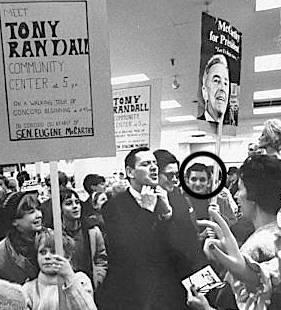
Dan Cirucci as he appeared in Life magazine (circled) holding the McCarthy for President sign and campaigning with actor Tony Randall in Concord, New Hampshire in 1968.
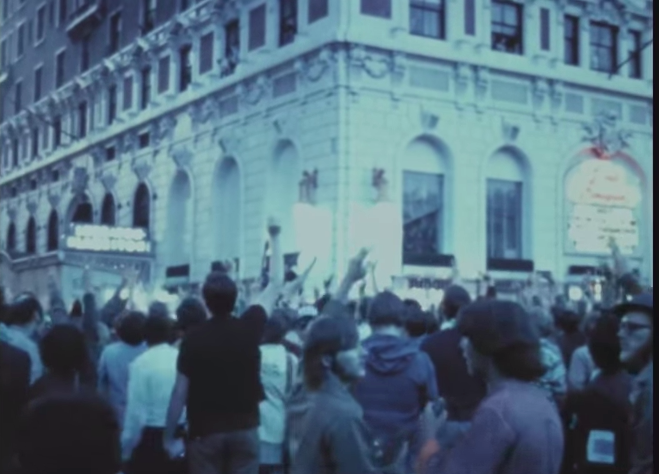
In August, the party convention was a veritable bloodbath. Those of us who were part of the “McCarthy kids” were called off the streets of Chicago by the candidate himself. He spoke to us calmly and responsibly and allowed us to camp out at his headquarters in the vast Conrad Hilton Hotel. From a lobby mezzanine above the street, we watched it all play out — the confrontations with the police, the tear gas, the beatings, the bloodshed. We chanted again and again: “The whole world’s watching!”And the world was watching and reacting. Inside the convention hall, the scene was equally ugly and the Democrat Party was literally torn apart.
Of course, there were no 24-hour news networks and no cellphones, Facebook, Twitter, Instagram, email or GoFundMe. We had to advance our cause by knocking on doors, dialing rotary phones, licking envelopes, operating mimeograph machines and collecting donations on street corners. The closest we got to any demographic analysis of our movement was a mailing list.
Activists came and went, grouped and regrouped, lost track of one another and then maybe reconnected at another time and place.
Our greatest accomplishment was ending the LBJ era. That alone was unprecedented. After Johnson announced that he would not seek re-election we marched through the streets singing “ding, dong, the witch is dead!” And even though our candidate didn’t prevail in the end, we felt that we had fought the good fight and remained true to our principles.
But how much difference did all that really make?
We made a lot of noise and expended a lot of youthful energy, true. But in the end, Richard Nixon preached the gospel of “law and order,” mobilized the “great silent majority” of Americans and became President of the United States.
The entrenched forces in both political parties mostly prevailed. The Washington establishment (now known as “the deep state”) remained intact. The Vietnam war continued. Poverty and inequality persisted. The government grew larger. And Nixon, scheming and paranoid as ever, bungled his way into Watergate.
Of course, all of this set the stage for Ronald Reagan. But that was still more than a decade away.
Even though today’s activists are much more technologically advanced and sophisticated, the establishment is betting that few of those who are part of the current movement will buckle down and remain in the fight for the long haul. Many are simply too impatient. Others become battle weary.
The lesson for all of them would seem to be clear: Be careful what you wish for!
A postscript: For my own part, I’ve still got the scars from my early involvement. But that’s OK, because I learned from it all. It strengthened and toughened me. And I’m one of those who has stayed involved.
My politics changed over the years. I embraced new causes and new heroes. But I’ve never walked away from the arena, lest I forfeit the most coveted title of all: engaged citizen.
Don't trample on Memorial Day. Don't treat like just another three-day weekend. Don't herald it as the beginning of summer because, well -- because it's not! And don't ever, ever ignore what it means or stands for or who it honors. I'm saying all this because for me, this day is personal. On this day, I remember Frank Bushey, Victor Gross and John Halladay. They all died while serving our nation in Vietnam. And they were all high school classmates of mine. Yes, I remember them and I think about them often. THIS is what Memorial Day is all about. It's about those who served and made the ultimate sacrifice. I hated the Vietnam War. Hated it! And I hated it even more after it took these three young men. There's nothing glamorous or adventurous about war. That's the movie version. What you see above is what happens in the real life version -- all to real, painfully real, heart-breakingly real. Honoring those who gave their all is our way -- a very small way -- of trying to show how indebted we are to those who went to war and never came home. It's our way of remembering them and their families and friends who were left with incalculable loss. It's our way of trying to extend a measure of comfort to those who still grieve, who still miss their loved ones. These were young lives cut short in their prime -- never to blossom and reach their full potential. Memorial Day is a personal thing -- something multiplied hundreds and thousands of times over and beyond the few faces that you see above. Remember them. Honor them. Show gratitude for their service. Keep them in your hearts. Never, ever, ever forget!
We need a goal.
We've got to know how this will end -- and when.
Yes, when!
We can't be dreaming of the moment, planning for the moment, rehearsing the moment without knowing when the moment will be. We cannot live in a state of amorphous suspension.
We need an end game. If we don't have one, then this is just a sort of economic Vietnam -- a humiliating mess with no goal and no end in sight.
Who effed up our efforts in Vietnam? Don't you remember? It was the so-called "experts" -- the functionaries, the bean counters, the technocrats and the bureaucrats. And our "leaders" at the time listened to them and followed their advice. And these experts kept buying more and more and more time, to hide their dirty little secret, which was that they made it up as they went along. And so it went along forever. This is a sort of domestic Vietnam compressed into days instead of years. And we're doing it to ourselves. We've making this mess ourselves.
The damage to the economy and our way of life is exponential -- yes, every bit as exponential (maybe even more so) as the virus itself. The damage to our everyday lives (both individually and collectively) is not only incalculable -- it's monstrous and devastating. Think of it in terms of mass anxiety, suspicion and a sort of ongoing calamity. It will show itself in the form of depression, addiction, even suicide. We cannot go on like this.
And so we must demand a definitive date with NO further postponements. Indeed, we're owed such a date. And if we have a date, we can do it. We're Americans. To hell with the experts and the whole damned deep state. We will rise to the challenge. We'll be ready for our Opening Night.
Yes, the theater's been dark long enough. So tell us Mr. President: When does the curtain go up on America again?
Air Force One touched down in Hanoi, Vietnam, at 8:54 a.m. ET this morning as President Donald J. Trump prepares for his second summit with Chairman Kim Jong Un of North Korea this week.
“As part of a bold new diplomacy, we continue our historic push for peace on the Korean Peninsula,” President Trump said in this month’s State of the Union address.
Last June’s meeting in Singapore marked the first time in history that an American president has met with the leader of North Korea. This week’s summit looks to build on the progress made that day, including transformed relations between the two countries and the complete denuclearization of the Korean Peninsula—a goal that seemed virtually unachievable for decades.
America’s negotiations with Chairman Kim are already producing results, both for our citizens and for our allies:
North Korea has not conducted a nuclear weapons or missile test in more than 400 days.
The regime has committed to dismantling its plutonium and uranium enrichment facilities.
American citizens are no longer detained in North Korea.
North Korea has returned remains of Americans who died during the Korean War—and President Trump is working to return more.
President Trump’s strategy is working where past administrations have failed for one reason above all else: America wins when it negotiates from a position of strength. Upon taking office, President Trump mobilized a global coalition to enforce a maximum pressure campaign on the regime in Pyongyang. He made clear that the world would not accept a nuclear-armed North Korea—and that provocations would come with a cost.
Now, instead of hopelessness, there is opportunity. The President has made clear that should Chairman Kim follow through on his promise to denuclearize, the Trump Administration will work to ensure there are economic development options for North Korea. The United States and its partners are prepared to explore how to mobilize investment, improve infrastructure, enhance food security, and more.
“Our hostages have come home, nuclear testing has stopped, and there has not been a missile launch in more than 15 months,” President Trump told Congress three weeks ago. There is still work to be done, but the early returns are clear: A strong United States of America makes for a stronger, safer world.
Watch how he tried to weasel out of a Big Fat Lie, claiming he 'misspoke'.
Now, Blumenthal dares to lecture us about "honest, truth, integrity".
What a joke -- and a really sick joke at that!
Dan Cirucci as he appeared in Life magazine (circled) holding the McCarthy for President sign and campaigning with actor Tony Randall in Concord, New Hampshire in 1968.
Those high-schoolers marching for stricter gun-control measures?
I wouldn’t dismiss them quite so easily. Nor would I underestimate the impact of a national youth-driven movement.
That’s because I was part of just such an effort exactly 50 years ago this spring.
In 1968, the media called it a “children’s crusade.” But those of us who participated were hardly children, even though many of us were novices to the pugnacious world of national politics. We were mostly college kids watching our contemporaries die by the thousands in a senseless war halfway around the world.
I lost four of my high school classmates in Vietnam. Multiply that figure out across the nation and over the decade-long war and you have more than 58,000 fatalities.
In the spring of 1968, we were in the throes of it. And I was a senior at Villanova University. I knew that I could not simply stand aside and watch the carnage continue. So, as a political science major, I decided to work within the system to bring about change.
I joined the campaign of the Democratic peace candidate, Sen. Gene McCarthy. The cerebral senator was the only Democrat who dared to challenge President Lyndon Johnson early on. Few people gave him any chance of dethroning an incumbent president. But that didn’t matter to me when I joined some of my classmates and went to work for McCarthy in New Hampshire, where he unexpectedly captured such a huge portion of the primary vote that he sent shock waves through the party establishment. By the end of March, Johnson bailed and announced he would not seek re-election.
I followed McCarthy through other primary states (New York, Indiana, Pennsylvania) and on to the infamous Democratic National Convention in Chicago.
By that summer, the nation witnessed horrific events. The Rev. Martin Luther King Jr. was assassinated in April and Senator Robert F. Kennedy (who had entered the presidential race and may have been headed toward the nomination) was gunned down in June.
A high school classmate writes of a Christmas he spent in a danger zone on the other side of the world in 1969:
The year is 1969, still at Fire Support Base Hunter, Viet Nam. It is hard to get into the Christmas spirit when it is 90 degrees every day. With Christmas coming we were receiving tons of cards, letter, packages with home made cookies, which we all ate, and many 3foot pre decorated Christmas trees. On Christmas eve we sat around, talking about what our families were probably doing, what they were having to eat....what their traditions were.....a group of guys decided to go around singing Christmas songs, they started near us and it sounded pretty good. You have to understand, there is no noise....it is quiet at night, no lights, only the moon if it was out....so as the group moved around the fire base and got on the other side, we could hear their voices gently singing in the night......It was one of the most moving and emotional times for all of us. A little later, the radio relay station on top of the only mountain in the area decided to start shooting off red and green flares, what a show....so not to be outdone all the fire support bases in the area did the same thing....it was a great display. Christmas is a difficult time to be away from home, but when you are with people who are family, and remain so till today, I am glad I had the chance to share it with them. I wish all my brothers and their families a Very Merry Christmas and a Happy New Year.
A classmate from Camden NJ's Woodrow Wilson High School shares this poignant Thanksgiving memory:
Thanksgiving brings back many different memories as the day goes on. The smells remind me of my mom’s kitchen and her great food....watching a football game takes me back to the Woodrow Wilson / Camden games....but the taste of turkey takes me back to another place. Thanksgiving 1969, I was a young sergeant in Viet Nam......We were told we would have the day off, and at lunch we would have our Thanksgiving Feast......Well as sometimes happens the Army decided some Engineers needed security to finish a job ( God only knows why it couldn’t wait a day ) and my platoon was selected to secure them We packed up our gear to include C-Rations for lunch.....yes...ground turkey in a can.... We got to the engineers, secured them, it was safe, the kids and sandwich ladies were there so we knew it would be an easy day. At lunch time we broke out the C’s and when the engineers noticed they stopped us, they said HOT TURKEY was on the way....a chopper came in and unloaded....they had serving tables, with table cloths and all this food, Turkey, Stuffing, Sweet and Mashed Potatoes, Pies...everything......We ate off of metal trays, there was so much the kids and ladies ate with us and they even took left overs home...... When I taste my turkey today, it will take me back....sitting in a field, on the ground, with my brothers eating and enjoying the day.....a day I will never forget....I wish all my brothers a Happy Thanksgiving, I hope they remember that day also, so they will think of us......and to you all, be thankful and grateful for all we have......especially our families.....